
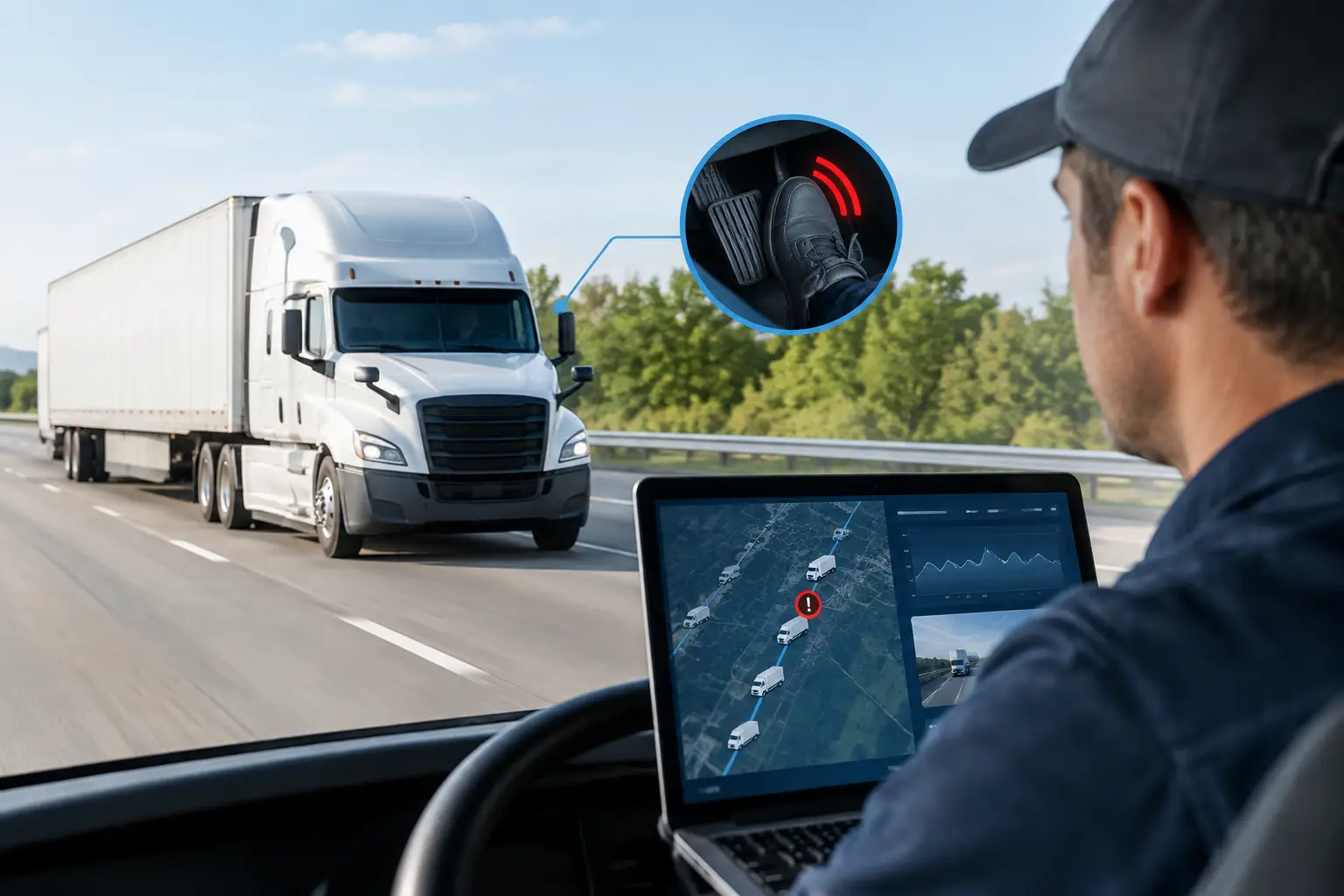
A harsh-braking alert can signal a distracted driver, a following-distance problem, an unexpected pedestrian, a cut-in at a roundabout or simply a loaded vehicle responding to changing road conditions. That is why harsh braking fleet monitoring must do more than count events. It needs to give fleet teams the context to identify genuine risk, coach fairly and act before a near miss becomes an incident.
For Australian operators managing heavy vehicles, construction plant, waste collection vehicles or service fleets, braking events are also an operational signal. Repeated harsh braking can increase wear on tyres and braking components, affect fuel use, disrupt a load and expose a business to greater safety and compliance scrutiny. The value lies in turning that signal into an evidence-based safety process.
What harsh braking events can tell a fleet
Telematics hardware identifies harsh braking by measuring a rapid reduction in vehicle speed. The platform records the event against a configured threshold, typically alongside GPS position, time, vehicle speed and direction of travel. When paired with vehicle data and driver identification, this creates a usable record rather than a vague report that a vehicle was driven aggressively.
Patterns matter more than a single alert. One event on a congested urban route may be unavoidable. Several events on the same road, at similar times, may point to a route hazard. Frequent events from one driver across different vehicles and locations may indicate following distance, fatigue, distraction or a training need. Events concentrated in a particular vehicle may warrant a mechanical inspection.
For heavy fleets, interpretation must account for vehicle type, payload and operating environment. A concrete agitator travelling to site, a loaded tipper leaving a quarry and a waste truck making frequent suburban stops do not brake in the same way as an empty light commercial vehicle. Applying one generic threshold across every asset can create noise, frustrate drivers and obscure the events that genuinely require attention.
Why event counts alone create the wrong incentives
A dashboard showing the highest number of harsh-braking events may look decisive, but it is not a complete safety assessment. Drivers assigned to dense metropolitan routes, school zones, landfill sites or difficult delivery locations will naturally encounter different conditions from drivers on open regional runs.
Treating every event as driver fault can lead to under-reporting, poor engagement and defensive driving behaviour that is not necessarily safer. It can also cause supervisors to spend time reviewing low-value alerts while significant risk is missed.
A better approach considers the event within its operating context. Review the road speed, posted route conditions, time of day, vehicle class, load state where available and nearby events such as speeding, harsh acceleration or sharp cornering. Driver camera footage can add a further layer of evidence, showing whether a vehicle cut in, traffic stopped suddenly or the driver was looking away from the road.
This does not reduce accountability. It makes accountability credible. A driver who repeatedly brakes harshly after following too closely needs a clear conversation and targeted coaching. A driver who braked hard to avoid another road user should be recognised for avoiding a collision, while the route or site hazard is reviewed separately.
Building a practical harsh braking fleet monitoring process
Effective monitoring starts with a policy that drivers, supervisors and safety leaders understand. Define what constitutes an event for each relevant vehicle category, who reviews alerts, what evidence is considered and when coaching or escalation is required. The policy should make clear that telematics supports safer decisions and operational improvement, not a blanket disciplinary tool.
Set thresholds for the work vehicles actually do
Thresholds should reflect the vehicle and task. A light ute operating on sealed roads can be assessed differently from a prime mover, a loaded concrete truck or a machine moving within a constrained worksite. Seasonal weather, unsealed access roads and local traffic conditions may also affect what is reasonable.
Start with manufacturer guidance, operating knowledge and a review of existing event data. Then test the settings against real journeys. If the platform produces hundreds of alerts with no meaningful safety issue, the threshold may be too sensitive. If serious incidents are not appearing in the data, it may be too lenient or the data may not be reviewed with sufficient urgency.
Review events by risk, not just volume
Prioritise events that combine multiple risk indicators. Harsh braking following a speeding event, occurring near a school zone, or accompanied by an in-cab distraction alert deserves faster attention than an isolated low-speed stop in traffic.
A sound review record should bring together:
- the vehicle, driver, location, time and speed at the event;
- the route, vehicle type and operating condition;
- related telematics events before and after the brake application;
- available camera footage or site information; and
- the action taken, including coaching, maintenance checks or route changes.
This gives safety managers a defensible audit trail and enables consistent treatment across depots and supervisors. It also helps identify recurring operational causes that cannot be solved by driver coaching alone.
Coach close to the event
Feedback is most effective when it is timely, specific and respectful. A supervisor can use the event record to discuss what happened, ask for the driver's perspective and agree on a practical action. That may involve increasing following distance, adjusting approach speed at a known intersection, refreshing fatigue controls or reporting a site access issue.
The conversation should focus on behaviour and conditions, not assumptions. Where footage or data shows unsafe conduct, the evidence is clear. Where conditions made the stop unavoidable, the driver has an opportunity to explain the circumstance and contribute to a safer operating plan.
Over time, this process supports measurable improvement. Managers can track event rates per distance travelled, per operating hour or per route, rather than relying on total event numbers that favour smaller fleets or lower-utilisation vehicles.
Connecting braking data to maintenance and compliance
Harsh braking is primarily a safety indicator, but it can also inform maintenance planning. Repeated severe events can place additional stress on braking systems, tyres and suspension, particularly on heavy vehicles carrying variable loads. Data should not replace scheduled inspections or defect reporting, but it can help maintenance teams prioritise assets for closer review.
For organisations operating under HVNL requirements, telematics evidence can strengthen the broader safety management picture. Location history, driver identification, fatigue workflows, pre-start checks and event records can show that risks are being actively monitored and addressed. No single alert proves compliance, and no fleet platform removes an operator's legal responsibilities. What it can provide is reliable, time-stamped information to support decisions, investigations and continual improvement.
This is particularly useful when an incident occurs. Rather than manually reconstructing a journey from paper records, a fleet team can review the vehicle's route, speed profile, braking event, associated camera footage and driver status. Fast access to accurate data supports a proportionate response and helps preserve evidence while details are fresh.
Choosing technology that supports action
The hardware, platform and support model behind the alert matter. A fleet may have quality data in one system, camera footage in another and compliance records in a third, leaving supervisors to piece together the story manually. Fragmented ownership also makes fault resolution difficult when a device, installation or workflow needs attention.
An integrated platform can bring vehicle tracking, driver behaviour, camera events and compliance workflows into one operational view. For complex Australian fleets, the provider should understand heavy-vehicle requirements, mixed asset types and the reality of field deployment across depots, work sites and remote locations.
Netcorp provides Australian-designed hardware and a locally supported fleet platform for this type of operating environment, including heavy vehicles, trailers, plant and specialised fleets. The practical benefit is not simply another alert. It is the ability to turn an event into a reviewable record, a constructive driver conversation and a documented operational response.
Measure improvement without losing context
Set a baseline before declaring success. Review harsh-braking rates alongside crash and near-miss data, speeding trends, driver turnover, maintenance findings and route changes. A lower event count is positive only if it reflects safer driving rather than lower utilisation, changed thresholds or missed data.
Share meaningful results with drivers and supervisors. When a team improves following-distance behaviour or identifies a hazardous access point, show the outcome. Visible feedback builds trust in the system and reinforces that monitoring is being used to reduce risk, protect people and keep vehicles productive.
The strongest fleets do not use harsh-braking data to find someone to blame. They use it to understand the road, vehicle, task and driver decisions behind each event - then make the next journey safer.