
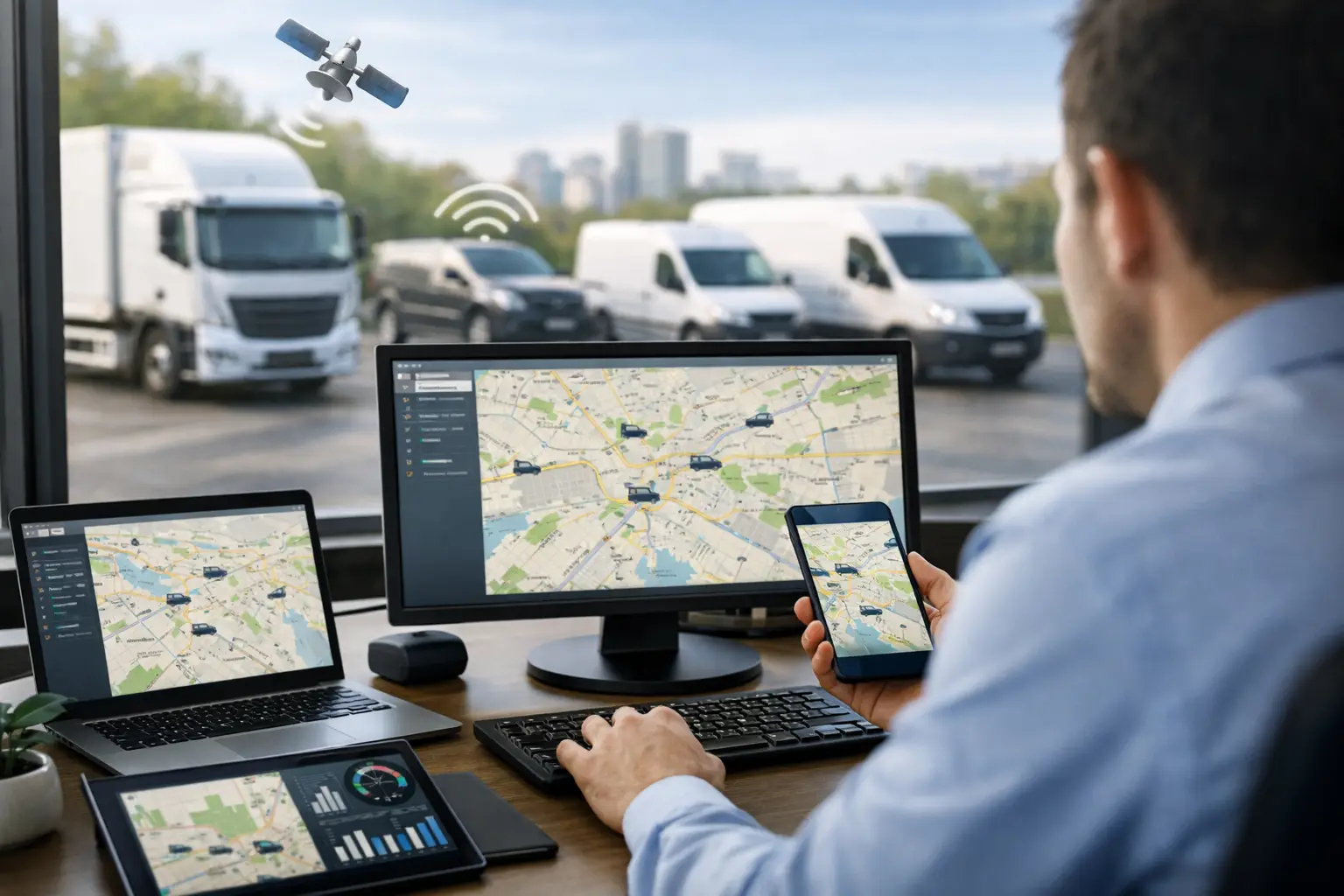
A concrete agitator held at a job longer than planned, a waste truck idling between runs, or a plant item moved after hours can each affect the day’s margin. Fleet telematics turns those events from assumptions into verified operational data. For Australian fleet operators, that means knowing where work is occurring, whether vehicles are being used safely and productively, and where avoidable cost is entering the business.
The value is not simply a dot moving across a map. A properly deployed telematics system connects vehicle location, route history, engine activity, driver behaviour, asset status and safety events in a form that supervisors can act on. It gives managers a reliable operational record while vehicles, drivers and equipment are spread across multiple sites.
What fleet telematics should deliver
At its core, fleet telematics combines in-vehicle hardware, GPS positioning, mobile communications and a central fleet platform. The hardware collects information from the vehicle or connected equipment, then transmits it for reporting, alerts and day-to-day decision-making.
For a light commercial fleet, that may begin with live location, trip history, speed and ignition status. For a heavy vehicle operation, the requirement is usually broader. Operators may need to monitor work and rest activity, pre-start checks, mass-related information, engine hours, trailer movements, harsh driving events and site arrivals. A construction or plant fleet may also need visibility of machinery hours and unauthorised movement when an asset is not on the road.
The right outcome depends on the operation. A business running a small service fleet may prioritise dispatch accuracy and overtime control. A transport operator may place compliance, fatigue and driver safety first. Concrete, waste and civil fleets often need all three, with reporting that reflects how work is actually allocated and completed in the field.
Real-time visibility is only useful when it changes action
Live tracking helps a control room answer immediate questions: which vehicle is closest, has a driver arrived on site, is a delayed job likely to affect the next allocation, and where is a trailer or machine currently located? This can reduce unnecessary calls to drivers and give customers more accurate arrival information.
However, visibility alone does not solve poor scheduling. If route plans, work allocations and site constraints are not considered, a map can create more data without improving decisions. The fleet platform needs to present exceptions clearly, so supervisors can focus on vehicles that are late, stationary too long, operating outside an approved area or approaching a safety threshold.
Geofencing is particularly useful here. By setting defined virtual boundaries around depots, customer sites, transfer stations, quarries or project locations, operators can capture arrival and departure times automatically. These records help validate service delivery, identify time spent waiting and build a clearer picture of actual job duration.
Safety data needs context, not just alerts
Driver behaviour data can identify speeding, harsh braking, rapid acceleration, harsh cornering and extended idling. Used well, this information supports targeted coaching and helps managers identify patterns before they result in an incident, vehicle damage or customer complaint.
The trade-off is straightforward: excessive alerts quickly become background noise. A fleet manager does not need hundreds of notifications that do not account for vehicle type, route conditions or operating environment. Thresholds should be configured for the fleet, with serious events escalated and lower-level trends reviewed through regular reporting.
AI driver camera technology can add important context to safety events. Video verification can help distinguish between a genuine high-risk event and a telemetry trigger caused by road conditions. It can also support fairer conversations with drivers by giving safety managers evidence rather than relying on incomplete accounts after an incident.
This is not about treating telematics as a surveillance tool. The strongest implementations make the purpose clear from the beginning: reduce risk, support drivers, protect the public and provide accurate records when something goes wrong. Clear policy, driver consultation and consistent use of data are essential.
Compliance requires records that stand up to scrutiny
For heavy vehicle operators, telematics can support a more disciplined compliance workflow. Under the Heavy Vehicle National Law, businesses must manage fatigue, mass, vehicle standards and their broader chain of responsibility. The specific obligations vary by operation, but manual processes create common weaknesses: missing paperwork, inconsistent inspections, delayed reporting and limited proof that an issue was addressed.
A connected fleet platform can bring together electronic work diary workflows, fatigue-related information, pre-start checks, defect reporting and operational records. When these processes are completed in the field through a mobile device or in-vehicle system, managers can see exceptions earlier and retain a clearer audit trail.
Telematics does not remove an operator’s legal responsibilities. Nor does it make a compliance process effective by itself. The business still needs approved procedures, trained personnel, practical escalation paths and management follow-through. What the technology can do is make compliance activity visible, time-stamped and easier to verify.
For fleets managing NHVR Electronic Work Diary requirements, onboard mass processes or regular pre-start checks, integration matters. Separate systems may technically collect the required data, but fragmented records make it harder to manage exceptions and demonstrate control across the operation.
Asset utilisation exposes hidden cost
Vehicles and equipment generate cost whether they are productive or not. Fuel use, maintenance, finance, insurance and labour continue while a truck is idling, a trailer is unaccounted for or plant is parked at the wrong site. Telematics provides the utilisation data needed to challenge those costs with facts.
Engine hours, idle time, kilometres travelled, trip duration and location history can reveal where capacity is being lost. A repeated pattern of early starts, long waits or unnecessary return trips may point to a scheduling issue rather than a driver performance issue. Likewise, low utilisation may indicate that the fleet has more assets than the workload requires, or that equipment allocation needs attention.
The commercial benefit comes from acting on these patterns. Some operators use the data to revise run sheets, rebalance workloads or improve depot practices. Others use it to support maintenance planning, reduce unauthorised use or make better replacement decisions. The measure that matters is not how much data is collected, but whether it lowers avoidable labour, fuel, maintenance or downtime costs.
Choosing a platform for demanding Australian fleets
A fleet telematics provider should be assessed as an operational partner, not simply a hardware supplier. Ask whether the system can support the vehicles, trailers, plant and specialised assets in your fleet, and whether it can scale as requirements change. A generic tracker may be adequate for basic location reporting, but it may not suit heavy-vehicle compliance, sector-specific workflows or complex asset configurations.
Local deployment and support also matter. Installation quality affects data reliability, while responsive technical support limits disruption when devices, vehicles or operational requirements change. For larger fleets, information security, access controls and data governance should be part of the procurement assessment, particularly where driver video, compliance records and customer-site information are involved.
Netcorp Australia delivers an end-to-end Australian model, with Sydney-designed hardware, fleet platform capability and 24/7 technical support for complex operations. That approach avoids placing the fleet manager between separate hardware, software and support providers when a problem needs to be resolved.
Start with one measurable operating problem
The most effective telematics projects begin with a clear operational question. It might be whether overtime is driven by poor job allocation, why vehicles spend too long idling, whether pre-start checks are being completed, or how often trailers are left outside authorised locations. Establish a baseline before deployment, then set practical measures for improvement.
Bring operations, safety, compliance, IT and drivers into the process early. Each group sees a different part of the fleet, and each can identify requirements that may otherwise be missed. A phased rollout is often the sensible option for larger or mixed fleets, allowing the business to test reporting, alert settings and training before extending the system across every asset.
Fleet telematics earns its place when it makes the next decision easier: send the right vehicle, coach the right behaviour, investigate the right exception and retain the record needed to prove control.