
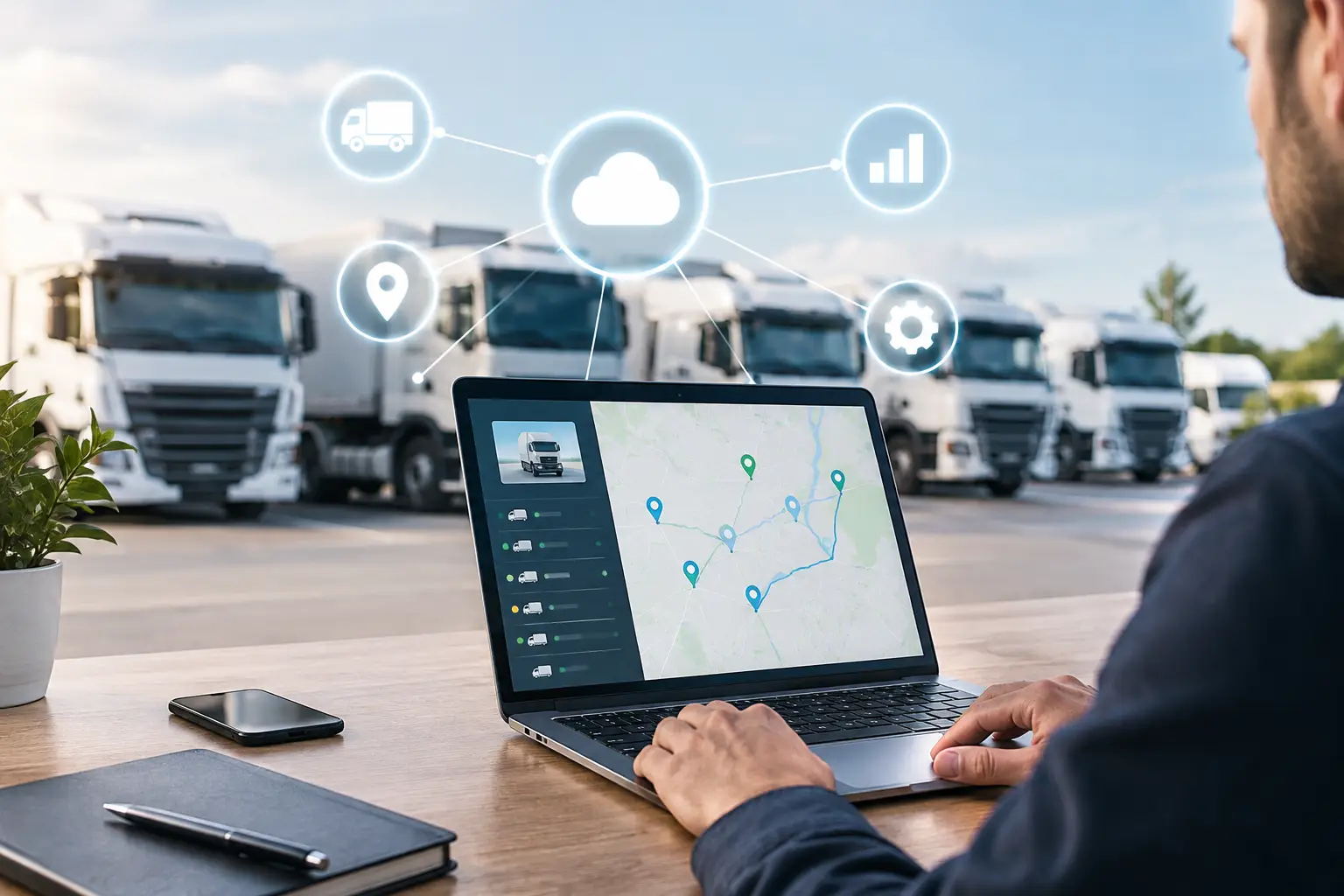
A fleet manager should not need to compare a telematics screen, a fatigue record, a maintenance spreadsheet and a job allocation system just to understand what happened on one shift. Fleet data integration brings those operational records together, so decisions are based on a complete picture rather than a series of partial answers.
For Australian fleets, this is more than an IT project. It directly affects vehicle utilisation, driver safety, customer service, payroll confidence and the ability to demonstrate compliance under HVNL requirements. The value comes from making existing data useful at the point where operators, supervisors and compliance teams need to act.
What fleet data integration means in practice
Fleet data integration is the controlled connection of data from fleet technology and business systems. This can include GPS tracking, vehicle diagnostics, AI camera events, electronic work diaries, onboard mass monitoring, pre-start inspections, maintenance systems, job dispatch platforms and payroll or ERP software.
The objective is not to put every available data point on one screen. It is to create a reliable operational record that lets the right person see the right information without rekeying data or chasing multiple teams for an answer.
Consider a heavy vehicle returning a harsh-braking event. In an integrated environment, the safety team can review the camera footage, the vehicle location, route conditions, speed context and driver details together. If the event occurred during a late delivery, the operations team can also see the job status and dispatch sequence. That context makes it easier to distinguish a genuine coaching opportunity from an unavoidable road event.
For concrete, waste, construction and plant operations, the same principle applies to assets that are not conventional trucks. Agitators, trailers, machinery and mobile plant each generate useful operating data, but only when that information can be matched to the job, operator, location and maintenance status.
Why disconnected systems create operational risk
Most fleet businesses do not set out to create fragmented technology. Systems are often added as the operation grows: one supplier for tracking, another for compliance, a separate camera platform, then a maintenance package and spreadsheets to fill the gaps.
The problem is not necessarily the individual products. It is the manual work required to reconcile them. A supervisor may spend hours each week validating timesheets against trip records. A compliance manager may have to export reports from several portals to prepare for an audit. Maintenance teams can be notified about a fault after a vehicle has already been allocated to another job.
This creates three practical risks. First, decisions are delayed because the data needs checking. Second, records become inconsistent when staff enter the same information in different systems. Third, fleet teams begin to work around the technology, relying on phone calls and spreadsheets where there should be an auditable workflow.
In regulated heavy-vehicle environments, that last point matters. Compliance evidence needs to be accurate, accessible and retained in a form that supports investigation or audit. A disconnected record does not automatically mean non-compliance, but it makes compliance harder to prove.
Where integrated fleet data delivers the strongest return
The best integration priorities are usually found in repetitive tasks where teams currently spend time chasing information. The commercial return can be significant, but it depends on the workflow being improved.
Dispatch, location and job status
Live vehicle location is useful on its own. It becomes more valuable when connected to job allocation and proof-of-service processes. Dispatchers can identify the closest suitable vehicle, monitor whether a job is progressing as planned and give customers more credible arrival updates.
For concrete and aggregate operations, visibility may need to extend beyond a vehicle’s position. Fleet teams may need to understand agitator activity, time on site, route progress and turnaround patterns. This gives operations staff the information needed to manage exceptions before they become missed pours, idle time or costly rework.
Safety events with operational context
Camera and telematics systems can generate a high volume of safety events. Without context, reviewing them can consume considerable supervisor time and lead to inconsistent responses.
Integrating AI camera events with vehicle data, driver identity and job activity allows teams to prioritise what needs attention. A fatigue-related alert, distracted-driving event or repeated speeding pattern can be reviewed alongside the actual operating conditions. The result should be better coaching, faster escalation where required and a clearer record of the action taken.
Compliance records that stand up to scrutiny
Fatigue management, electronic work diaries, mass monitoring, pre-start checks and inspection records are often managed by different people at different points in the day. When these workflows share accurate vehicle, driver and time data, duplicate administration is reduced and exceptions are easier to identify.
Integration does not remove the need for sound procedures or accountable staff. It does make those procedures easier to follow. For example, a missed pre-start check can be flagged before a vehicle leaves the depot, rather than being discovered at the end of a shift. A fatigue issue can be visible to the people allocating work, not only to the compliance team after the fact.
Maintenance based on real operating hours
Scheduled maintenance is more reliable when it reflects actual distance travelled, engine hours, utilisation and fault data. For plant, trailers and equipment, engine hours or operating cycles may be more relevant than kilometres.
An integrated maintenance workflow can trigger attention based on the asset’s real use and show whether a vehicle is available for allocation. The trade-off is that maintenance rules need to be configured carefully. Poor-quality asset records or incorrect service thresholds will simply automate the wrong decision.
Build the integration around decisions, not dashboards
A common mistake is beginning with a request for a single dashboard. Visibility is useful, but a dashboard alone does not improve a process. Start instead with the decisions that repeatedly cause delays, cost or risk.
Ask practical questions. Who decides whether a driver can be allocated another shift? Who identifies a vehicle that should be removed from service? Who confirms that a safety event was reviewed and acted on? What information do they need, and where does it sit now?
This approach also prevents data overload. Not every team needs access to every record. A dispatcher may need vehicle availability and job progress, while a safety manager requires event footage, driver history and coaching outcomes. IT teams need secure access controls, retention policies and assurance that integrations do not create new vulnerabilities.
For fleets operating across multiple depots, the data model matters as much as the display. Vehicle identifiers, driver IDs, asset classes, job references and site names need consistent rules. If one system identifies a truck by registration and another uses an internal asset number, the integration needs a dependable method to match them.
A practical path to fleet data integration
A staged implementation is generally safer than attempting to connect every system at once. Begin with a process that is high-volume, costly or compliance-critical, then prove that the information is accurate and useful before expanding.
First, map the current workflow from the field to the office. Include the manual hand-offs, spreadsheets and phone calls, not just the software platforms. These informal steps often reveal where information is being delayed or changed.
Next, establish ownership of the core records. There should be a clear source of truth for drivers, vehicles, assets and jobs. If two systems can overwrite each other without controls, data quality will deteriorate quickly.
Then define the exception workflow. It is not enough for a system to identify a defect, a fatigue issue or a safety event. The operation needs to know who receives it, how it is prioritised, what action is recorded and when the issue is considered closed.
Finally, measure the operational result. Useful measures may include time spent reconciling records, unplanned downtime, overdue checks, safety-event response times, overtime, unauthorised use or failed job attendance. The most valuable indicator will vary by fleet, but it should be tied to a business outcome rather than the volume of data collected.
Security and support are part of the integration
Fleet integration creates a broader operational picture, which means it must be designed with security and resilience in mind. Vehicle location, driver information, video footage and compliance records are commercially and personally sensitive. Access should reflect job roles, and the business should understand where data is stored, how it is retained and who supports the environment when an issue occurs.
This is where an end-to-end provider can reduce operational complexity. Netcorp combines in-house hardware, fleet technology, compliance tools and Australian-based support, helping fleets avoid the unclear ownership that can arise when several vendors are involved in one operational workflow.
The right level of integration depends on fleet size, existing systems and regulatory obligations. A regional contractor may gain the most value by connecting tracking, pre-starts and maintenance. A national heavy-vehicle operator may require deeper integration across fatigue, mass, dispatch, cameras and enterprise systems. In both cases, the standard is the same: trustworthy data that leads to timely action.
When fleet data is connected to the way work is actually planned, performed and reviewed, managers spend less time assembling the story and more time improving the next shift.