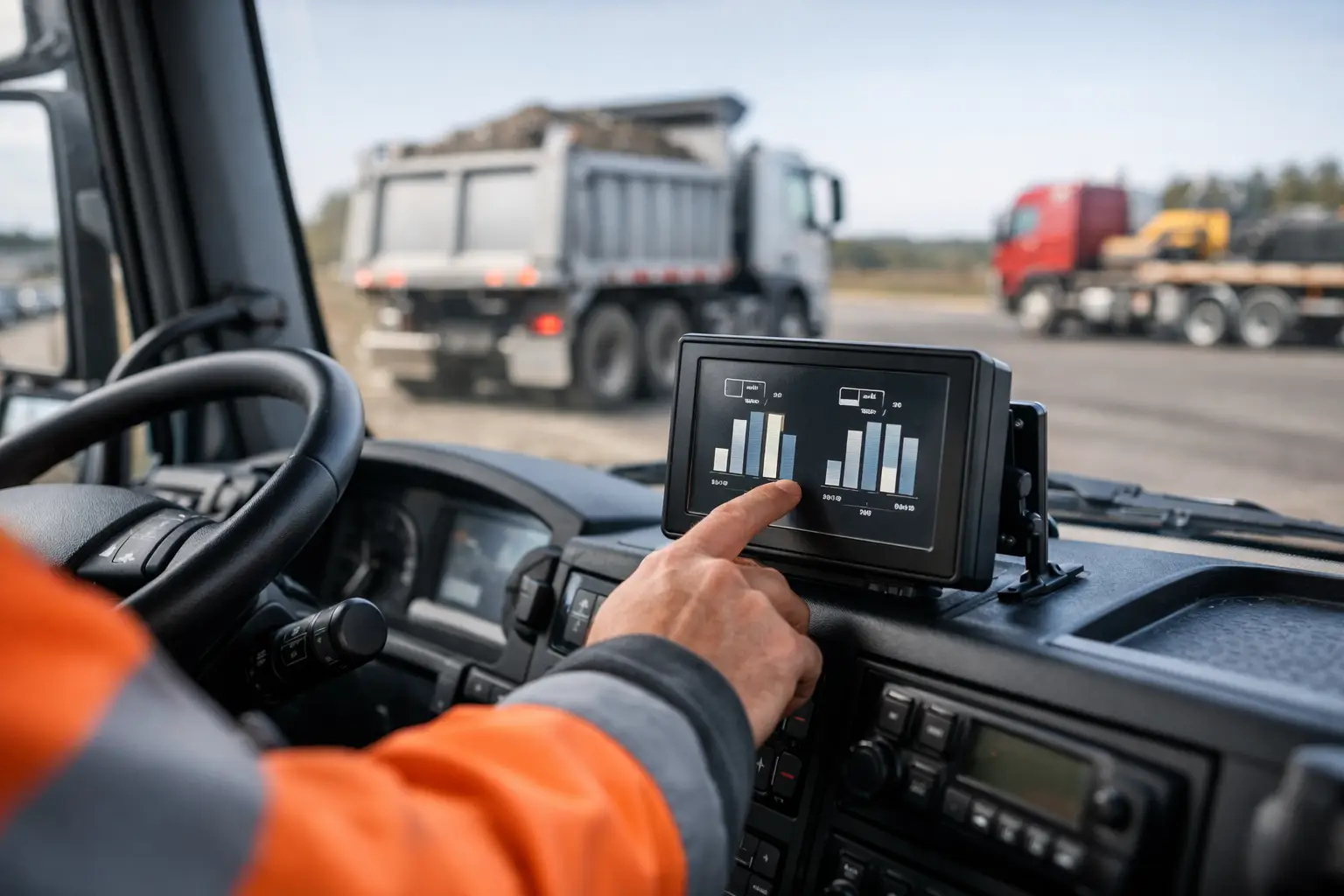
A truck can leave site with a valid-looking load and still be exposed to a mass breach before it reaches the first weighbridge. For concrete, aggregate, waste and bulk transport fleets, load variation is part of the job. An onboard mass management system gives operators and drivers a practical way to see estimated mass at the vehicle, manage axle-group distribution and make better decisions before the vehicle enters the road network.
The value is not simply another number on a driver display. When it is properly installed, calibrated and supported by a clear workflow, onboard mass technology can reduce avoidable rework, support compliance processes and give the transport office a more reliable record of what occurred at loading and dispatch.
What an onboard mass management system does
An onboard mass management system uses sensors and vehicle data to estimate mass across individual axle groups and gross vehicle mass. Depending on the vehicle configuration and approved operating arrangement, data may be displayed in the cab, sent to a fleet platform, or both.
This changes the conversation at the loading point. Instead of relying solely on a visual assessment, a loader operator, dispatcher or driver can identify whether the vehicle is approaching a mass limit and whether the load is distributed correctly. That matters because a compliant gross mass does not automatically mean every axle group is compliant.
For multi-combination vehicles, tippers, dog trailers, agitators and collection vehicles, distribution can shift as work progresses. A system that provides visibility during loading and throughout the shift helps the operation respond to those changes earlier.
Mass visibility needs to be operationally useful
A screen in the cab is only useful when the information is clear, timely and matched to the work being performed. Drivers need to know what they are looking at, what the approved limits are for their configuration and who to contact if a reading indicates a problem.
Operations teams also need data they can act on. If recurring overload alerts occur at one quarry, transfer station or batch plant, that is not just a driver issue. It may point to a loading process, product density assumption, trailer setup or training gap that needs attention.
The strongest outcomes come when mass data is connected to vehicle identity, trailer configuration, location, time and driver activity. That context makes an event easier to investigate and reduces the time spent piecing together paper records, messages and weighbridge tickets.
Compliance confidence requires more than a sensor
Heavy vehicle mass compliance remains a shared responsibility. Drivers, schedulers, loaders, consignors and operators each have obligations under the Heavy Vehicle National Law. An onboard system can support a fleet's controls, but it does not remove the need to understand applicable mass limits, permits, route restrictions or Chain of Responsibility duties.
It is also not a substitute for a certified weighbridge where one is required. Onboard mass readings are influenced by system design, installation quality, calibration, suspension condition, vehicle configuration and the operating environment. Operators should understand the purpose and limitations of their chosen solution, particularly where an approved onboard mass arrangement is being used as part of a defined compliance program.
A practical compliance process sets out what happens when a mass threshold is reached. That may include stopping loading, redistributing material, removing part of the load, checking the vehicle configuration or escalating the matter to a supervisor. The process should be documented, understood by the people doing the work and reviewed when exceptions occur.
Records that stand up to scrutiny
A useful record does more than show a mass figure. It should establish when the reading was taken, which vehicle and trailer were involved, the relevant axle-group values, location where available, and any action taken after an alert.
This is where an integrated fleet platform has a clear advantage over isolated hardware. When mass information sits alongside GPS location, route history, driver identification and pre-start records, a fleet can produce a fuller operational picture. It also helps compliance leaders identify patterns before they become repeated breaches.
The right retention period and reporting format will depend on the operator's obligations, customer requirements and internal policies. What matters is that data is accessible, consistent and protected. A record that cannot be found quickly during an audit has limited operational value.
Better loading decisions protect productivity
The immediate benefit of onboard mass is avoiding the obvious cost of travelling overloaded. But the commercial gains can be broader.
At a busy site, an overloaded vehicle may need to return to the loading area, unload material and rejoin the queue. That creates lost time for the driver, loader, dispatch team and customer. It can disrupt planned deliveries and increase the pressure on everyone to recover the schedule later in the day.
Conversely, fleets that consistently underload due to uncertainty can lose revenue capacity on every trip. The objective is not to chase maximum tonnes at any cost. It is to load safely and legally with greater confidence, using the available payload appropriately for the vehicle, route and operating conditions.
For waste fleets, mass visibility can help explain why a route is reaching capacity earlier than expected. For aggregate and quarry work, it can help improve consistency between loader operators and sites. For concrete operators, vehicle and axle loading data can support better dispatch decisions where payload, local access and delivery timing all need to be considered.
There are trade-offs. A simple in-cab indication may suit a small, stable fleet with predictable routes. A larger operation with multiple depots, trailer combinations and compliance reporting needs will usually benefit from live alerts, remote reporting and configuration controls managed centrally.
Selecting an onboard mass management system
The starting point is the fleet's work, not a feature list. A system suitable for a fixed-route rigid truck may not suit a road train, a body with changing load characteristics or a fleet that regularly swaps trailers.
Assess the vehicle types, suspension arrangements, axle groups, trailer combinations and typical loads. Consider where vehicles are loaded, whether connectivity is reliable at those sites, how frequently configurations change and who will be responsible for calibration and exception management.
A capable supplier should be able to explain how the hardware is installed on each vehicle type, how calibration is performed, what happens after suspension or body repairs, and how system accuracy is maintained over time. These are not minor technical details. Poor installation or neglected calibration can undermine driver confidence and the value of the data.
Integration should also be examined closely. A separate mass display may solve one immediate problem, but it can create another system for drivers and administrators to manage. Where possible, select technology that works with existing telematics, driver identification, fatigue, electronic work diary, pre-start and reporting workflows.
Implementation is where value is won or lost
A successful rollout begins with a pilot across representative vehicles and operating conditions. Include the people who load vehicles, drive them, dispatch work and review compliance records. Their feedback will quickly expose whether alert thresholds make sense, whether the display is understandable and whether the workflow is realistic during peak periods.
Training should focus on decisions, not just buttons. Drivers need confidence to recognise an out-of-tolerance reading and know the required response. Loader operators need to understand axle distribution, not simply gross mass. Supervisors need a consistent escalation process so that concerns are addressed without blame or confusion.
After deployment, review exceptions regularly. Look for repeated overload warnings, large differences between onboard readings and reference weights, vehicles that require recalibration and sites with inconsistent outcomes. This creates a cycle of improvement rather than treating the system as a once-only compliance purchase.
Support matters over the life of the fleet. Vehicles are repaired, trailers are reassigned and operating requirements change. Local technical support, clear service ownership and access to people who understand heavy vehicle operations make it easier to keep the system performing as intended.
Building mass management into one fleet view
Mass data is most valuable when it is part of daily fleet control. An operator should be able to move from a mass alert to the vehicle's route, driver, trailer, loading location and relevant compliance records without switching between disconnected systems.
Netcorp's Australian-designed fleet technology can bring onboard mass, telematics, driver workflows and heavy-vehicle compliance tools into one operational platform. For fleets managing demanding work across transport, construction, concrete, waste and plant, that approach reduces fragmented technology ownership and gives teams a clearer basis for action.
The right onboard mass management system does not promise that compliance will look after itself. It gives your people earlier, better information so they can load correctly, respond before a vehicle departs and build a more controlled operation one shift at a time.