
A telematics platform review should begin where fleet costs and risk actually occur: on the road, at the job site and in the office chasing incomplete records. For Australian fleet operators, the right system must do more than place dots on a map. It needs to give managers reliable evidence for vehicle use, driver safety, asset activity, customer service and heavy-vehicle compliance.
That distinction matters most in mixed and demanding fleets. A transport operator may need fatigue records and mass data. A concrete business needs visibility of agitator cycles and delivery timing. A council fleet may need to account for utes, plant, trailers and specialist equipment. Reviewing platforms against a generic feature checklist can miss the operational detail that determines whether a system is used, trusted and retained.
Start the telematics platform review with your operating risks
Before comparing suppliers, identify the decisions your team currently makes with incomplete, late or disputed information. This creates a practical benchmark for the review rather than a contest of dashboard screenshots.
Consider where time, money or compliance confidence is being lost. Common examples include unauthorised vehicle use, excessive idling, missed pre-start checks, disputed arrival times, incomplete driver records, overtime caused by poor dispatch visibility, and equipment that cannot be located when a crew needs it. Each issue should be tied to an owner, a current process and a measurable outcome.
For example, a waste contractor may require alerts for bin-lift activity, route deviations and harsh driving in residential streets. A civil construction business may care more about plant utilisation, trailer location and proof that pre-start checks were completed before work began. Both need telematics, but they should not score a platform in the same way.
A useful review asks three questions for every requirement: what event must be captured, who needs to act on it, and what record must remain afterwards? If a proposed system cannot answer all three, it may provide data without improving control.
Assess data quality before dashboard design
A polished map is not proof of dependable telematics. The operational value of any platform rests on the quality of its location, engine, driver and event data. Ask suppliers how often positions are reported, what happens in poor mobile coverage, how devices store data when offline, and how historical records are reconciled after a connection returns.
Hardware installation also deserves close scrutiny. Devices should be suited to the asset, its duty cycle and the data required. A light vehicle, a prime mover, an agitator, an excavator and a marine vessel do not present the same installation conditions. Where equipment is exposed to dust, vibration, wash-down or long idle periods, generic hardware choices can create failures, gaps and repeated workshop visits.
The platform should make it clear which information comes directly from the vehicle and which is inferred. Odometer readings, engine hours, ignition status, PTO use and fault information can be commercially valuable, but only if the source is understood and the data is consistently available across the fleet. A review should include a demonstration using the vehicle types you operate, not only a supplier's ideal test unit.
Test exceptions, not just normal journeys
Ask to see how the system handles a lost signal, a disconnected device, a driver changing vehicles, a trailer being coupled, an out-of-hours trip or a missed inspection. These are the events that expose gaps in configuration and support.
Also examine alert design. Too many alerts create alarm fatigue, while vague alerts leave managers with no clear action. Good systems let organisations set sensible thresholds by vehicle class, depot, route or operating condition. A harsh-braking threshold suitable for a loaded truck may be unhelpful for a light service vehicle.
Review compliance workflows as working processes
For heavy vehicles, compliance capability cannot sit apart from daily operations. The platform should help make the required process easier to complete correctly, provide a clear audit trail and surface exceptions before they become larger problems.
Australian operators may need support for HVNL responsibilities, NHVR Electronic Work Diaries, fatigue management, onboard mass, chain of responsibility evidence, inspection records and driver pre-start checks. The exact requirement depends on the operation, accreditation and jurisdiction, but the evaluation principle is consistent: assess the workflow from driver entry through to office review and audit retrieval.
During a demonstration, ask a supplier to show how a driver completes a check on a mobile device, what happens if a defect is reported, who receives the notification, how rectification is recorded and how the final record is retrieved months later. A digital form is not automatically a compliance system. It needs assigned actions, timestamps, records that cannot be casually altered and reporting that makes exceptions visible.
The same approach applies to electronic work and rest records. Look beyond whether the platform can capture a log. Review how drivers are guided, how schedulers see risk, how managers manage breaches, and whether records can be produced without manual reconstruction. Compliance confidence comes from repeatable workflows, not from storing more paperwork electronically.
Measure safety and productivity together
Telematics is often assessed through a safety lens or a cost lens. The better review considers both, because driver behaviour, route planning, idle time and vehicle use affect each other.
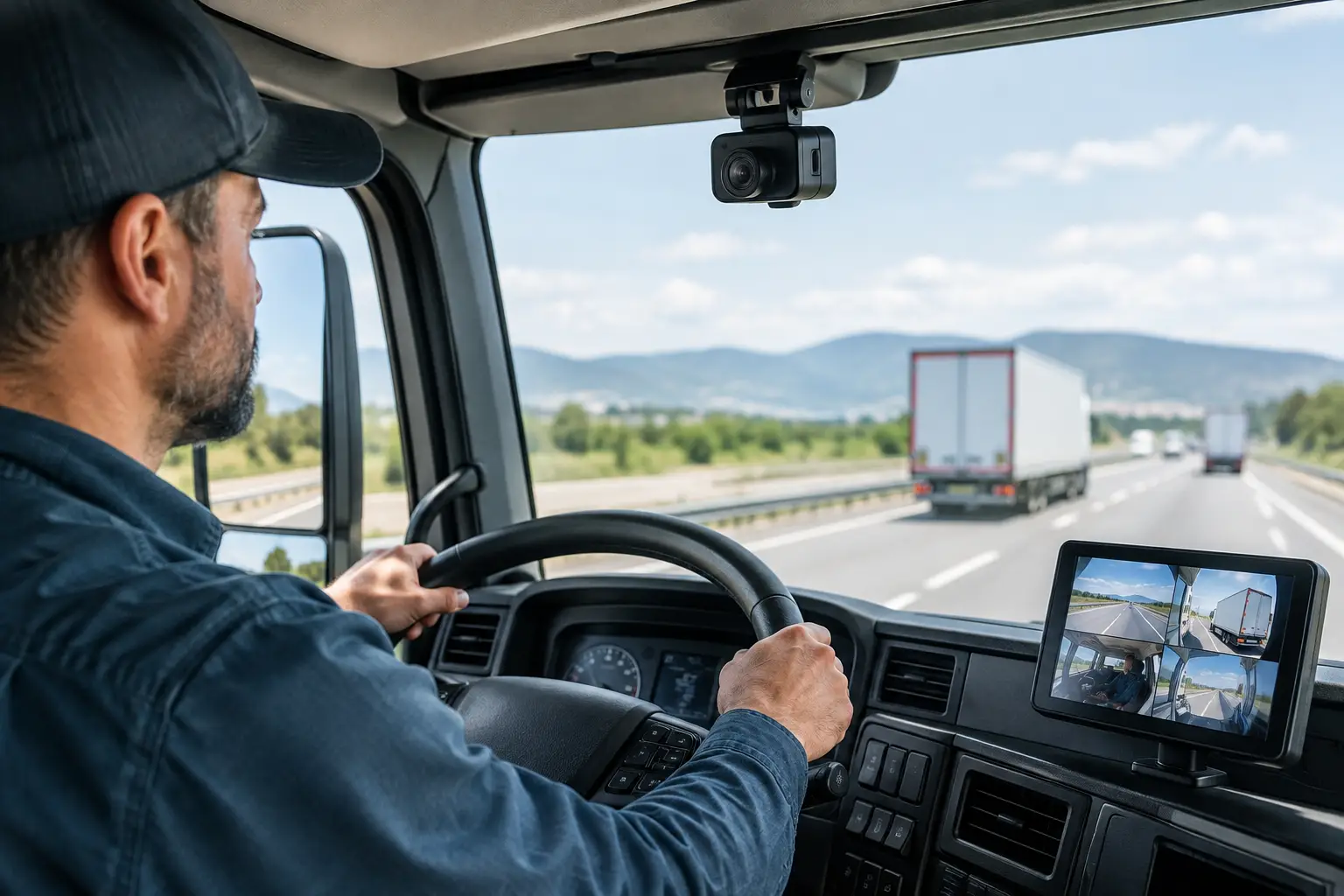
AI driver camera technology can add essential context to events such as distraction, tailgating, fatigue indicators, harsh braking or collision risk. Yet camera deployment requires clear policies, driver consultation, training and a defined review process. Video that is collected but not reviewed consistently offers limited protection. Video that is used only for discipline can quickly undermine adoption. The strongest programmes use verified events for coaching, recognition and targeted intervention, while maintaining clear escalation for serious risk.
Productivity measures should be equally specific. Rather than seeking an abstract promise of savings, establish a baseline for idle time, kilometres travelled, overtime, job turnaround, missed service windows, plant utilisation or unauthorised use. A platform should make those measures visible by depot, team, asset class and time period. This lets managers distinguish a real operating change from a one-off variation in workload.
For businesses with complex dispatch and delivery requirements, sector-specific tools can matter more than broad feature counts. Concrete operators, for instance, may need an operational view of vehicle status and activity that supports batching, deliveries and agitator management. The relevant question is whether the platform reflects how the work is performed, not whether it can be configured to resemble it after extensive manual effort.
Examine ownership, support and security
A telematics deployment is not finished when hardware is installed. Devices need maintenance, users need support, reporting needs refinement, and fleet changes need to be managed. Review who owns each part of that lifecycle: hardware supply, installation, platform configuration, user training, firmware updates, troubleshooting and replacement equipment.
An end-to-end provider can reduce the hand-offs that occur when one business supplies hardware, another hosts software and a third manages installation. That does not make every integrated provider the right fit, but it creates clearer accountability when a vehicle is not reporting or a compliance workflow needs adjustment. Ask for response arrangements, local support availability, escalation paths and the practical process for adding new vehicles or depots.
Information security should receive the same attention as vehicle tracking. Location history, driver data and operational records are sensitive business information. Assess access controls, user permissions, authentication, data retention, incident management and the supplier's security governance. ISO 27001 certification is a useful indicator of disciplined information-security management, while ISO 9001 can indicate a mature quality framework. Certifications are not a substitute for due diligence, but they are relevant evidence.
For Australian fleets, local expertise can also be material. Support teams that understand HVNL terminology, regional operating conditions and local deployment requirements can resolve issues with less translation and less delay. Netcorp Australia, for example, combines Sydney-designed hardware, fleet and compliance technology, and 24/7/365 support for operations that require clear ownership across the solution.
Compare total operating value, not subscription price
The cheapest monthly fee can become the most expensive choice if hardware fails early, reports require manual work, support is slow or separate systems create duplicate administration. Build the comparison around the full cost of ownership: hardware, installation, platform licences, camera equipment, mobile access, training, support, replacement devices and any integration work.
Then compare that cost with outcomes that can be measured. A reduction in overtime, lower idle time, fewer unauthorised trips, less time preparing audit records, faster recovery of misplaced assets and fewer safety incidents all have different values for different operators. Be cautious with supplier savings claims that do not state the baseline, time period or operating assumptions.
A short pilot is often more revealing than an extended sales process. Include representative vehicles, drivers and managers, set success measures before installation, and test the reports and workflows your team will actually use. At the end of the pilot, assess adoption as well as data. If dispatchers, supervisors and drivers cannot work with the system confidently, its technical capability will not translate into results.
The right platform should make the next operational decision easier: where the asset is, whether the work was completed safely, what requires attention and who is accountable. Choose the provider that can prove those answers in your fleet conditions, then give the implementation the same discipline you apply to the vehicles it supports.