
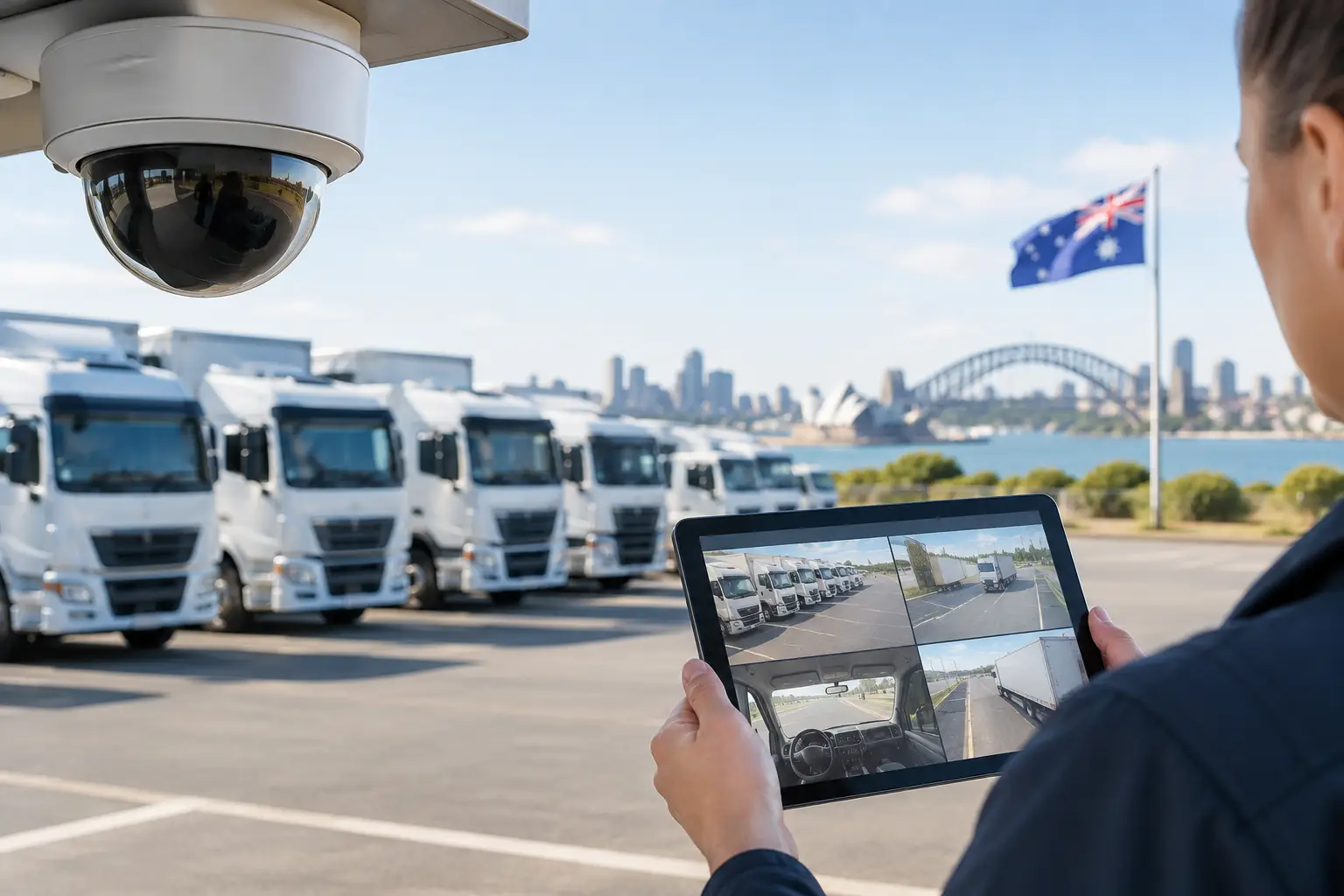
A driver-facing camera can explain a serious safety event in seconds. It can also create a privacy risk if drivers were not properly notified, footage is retained without a reason, or access is loosely controlled. Camera privacy compliance is therefore not a paperwork exercise for Australian fleets. It is the operating discipline that allows safety teams to use valuable evidence while treating employees, contractors and members of the public fairly.
For transport, construction, waste and concrete operations, the challenge is practical. Vehicles are mobile workplaces. Camera systems may capture road users, customer sites, private conversations, fatigue alerts, cabin activity and GPS-linked event data. The right approach protects the business from avoidable disputes while preserving the footage that matters after an incident.
What camera privacy compliance requires
Privacy obligations are not identical in every state, industry or employment arrangement. The Privacy Act 1988, the Australian Privacy Principles, state and territory surveillance device laws, workplace surveillance requirements and industrial arrangements can all be relevant. Public-sector fleets may also have separate state-based privacy obligations.
The starting point is to identify what the camera collects and why. A forward-facing camera used to review collisions presents a different privacy profile to an AI-enabled dual-facing system that records the cabin, detects distraction and uploads event footage. Audio recording, continuous livestreaming, facial identification and automated scoring can introduce additional obligations and higher expectations around notice, security and governance.
A defensible programme is built around a clear, legitimate operational purpose. Common purposes include reducing road risk, investigating collisions, verifying safety events, supporting driver coaching, managing insurance claims and protecting staff from false allegations. Vague objectives such as monitoring people generally are harder to justify and can quickly erode workforce trust.
Fleet leaders should ensure their policies answer straightforward questions: which vehicles have cameras, whether cameras are road-facing or driver-facing, when recording occurs, whether audio is enabled, what events trigger uploads, who can view footage, and how long it is kept. Drivers should receive this information before the system is activated, not after the first incident.
Start with necessity, not the camera specification
It is tempting to select a system based on lens count, AI alerts or storage capacity. Compliance starts earlier. Ask whether each data element is necessary for the intended safety outcome.
For example, a waste fleet with frequent urban reversing risks may reasonably need external cameras and event clips to investigate near misses. A driver-facing camera may be justified where fatigue, distraction or disputed incidents are a material risk, particularly for heavy vehicles operating long shifts. But continuous cabin recording may not be proportionate for every fleet, route or role.
This is where a documented privacy impact assessment is useful. It does not need to be an academic exercise. It should record the purpose, data collected, affected people, foreseeable risks, controls, retention period and person accountable for the decision. Revisit it when the fleet adds new AI functions, activates audio, changes cloud providers or begins using footage for a purpose beyond the original safety case.
The assessment should also consider contractors and visitors. A camera installed in a truck, ute, plant item or marine vessel may record workers who are not direct employees. Depot cameras and footage captured on customer sites bring further considerations. Privacy notices need to reflect the actual environment, not only permanent drivers.
Give drivers clear notice and fair expectations
In fleet operations, trust is shaped by what happens after the system is installed. A policy buried in an induction pack is not enough. Drivers and relevant contractors need clear written notice, supported by a conversation with supervisors who can explain how the technology works in the real world.
The notice should state the business purpose, camera locations, whether audio is captured, the types of footage reviewed, access arrangements, retention periods and how people can raise a concern. It should also explain that footage may be used when investigating a safety incident, complaint, insurance matter or suspected policy breach.
Avoid language that suggests every alert proves misconduct. AI camera technology identifies patterns and potential risks. It does not always establish context. A distraction alert may be caused by a glance to check mirrors or site conditions. A fatigue alert should trigger an appropriate safety response and a fair review, not an automatic disciplinary outcome.
Managers need the same clarity. They should understand that footage is not a tool for casual performance surveillance. Viewing should be tied to a defined event, authorised safety review, customer complaint, claim, training requirement or lawful investigation. Consistent rules help avoid perceptions that particular drivers or crews are being singled out.
Control access to footage from the outset
Video is sensitive operational data. When it is combined with location, timestamps, driver identity and vehicle activity, it can provide a detailed picture of a person’s workday. Giving broad access to a shared fleet portal may be convenient, but it is rarely appropriate.
Access should follow roles. A safety manager may need incident footage and event history. A supervisor may need to coach a driver on a specific alert. An IT administrator may need platform access but not a reason to review video content. Insurers, police and customers may seek copies, yet each request should be assessed against the purpose, authority and minimum information required.
A sound access model includes named user accounts, multi-factor authentication where available, permission levels, audit logs and a process for promptly removing access when a manager, contractor or employee changes role. Footage should not be downloaded to personal mobiles, emailed widely or saved indefinitely in local folders.
Security is not solely an IT issue. A lost mobile device, an exported clip sent to the wrong recipient or a supervisor sharing footage in a group chat can undermine an otherwise well-designed system. Training must cover everyday handling practices as well as technical controls.
Set retention rules that match operational reality
Keeping every recording forever creates cost, increases exposure and makes it harder to find what matters. Deleting footage too quickly can leave the business unable to investigate a serious event, respond to a claim or meet a legal preservation requirement.
There is no single retention period that suits every Australian fleet. The appropriate period depends on the purpose of the footage, contractual requirements, insurance arrangements, likely incident-reporting timeframes and applicable laws. The key is to set a documented baseline period, automatically delete ordinary footage when that period expires, and preserve specific clips when an incident or claim requires it.
A practical process distinguishes between routine recording and retained evidence. A harsh-braking clip with no complaint may be reviewed for coaching and then removed under the normal schedule. Footage associated with a collision, injury, reportable event, legal claim or formal investigation should be placed on hold and retained only for as long as necessary.
Retention settings must align across the fleet platform, camera hardware, cloud storage, exports and any third-party case management system. If the platform deletes a clip but an emailed copy remains in multiple inboxes, the retention policy is not working as intended.
Build camera privacy compliance into daily workflows
The most effective controls are the ones that fit into existing fleet processes. Camera technology should be included in driver induction, vehicle handover, incident response, supervisor training and periodic policy reviews. It should not sit separately from fatigue management, HVNL obligations, pre-start checks and broader safety systems.
A practical operating standard should cover at least these five areas:
- documented safety and operational purposes for each camera function
- clear driver, contractor and visitor notices before recording begins
- role-based access, audit trails and secure handling of clips
- scheduled deletion and formal preservation of incident evidence
- fair review processes for AI alerts, complaints and disciplinary matters
There are trade-offs. A short retention period reduces privacy exposure, but may be inadequate where customers report damage weeks later. Driver-facing video can strengthen incident investigation and coaching, but requires particularly careful communication and access control. Audio may assist in rare circumstances, yet it is more intrusive and should not be activated merely because the hardware supports it.
The right configuration also depends on the operation. A long-haul heavy vehicle fleet, an agitator fleet managing site activity, and a council services fleet working around the public will face different risk profiles. One policy copied across every division can leave gaps.
Choose providers that support governance, not just recording
Fleet camera compliance relies on more than a camera mounted to a windscreen. The provider needs to support secure deployment, configurable access, reliable event capture, records management and ongoing technical assistance. Integration matters too. Video that is linked to vehicle location, driver events and compliance workflows gives reviewers context, reducing the chance of drawing conclusions from a short clip alone.
For complex Australian fleets, an end-to-end platform can reduce fragmented ownership between camera suppliers, telematics vendors, IT teams and safety managers. Netcorp’s locally designed and supported fleet technology is built for this operational reality, with the capability to bring vehicle data, safety events and compliance workflows into one managed environment.
Before deployment, involve fleet operations, safety, HR, IT and legal or industrial relations advisers where appropriate. Test the policy against real scenarios: a collision claim, a driver request for footage, a customer complaint, an AI distraction alert and a manager leaving the business. If the team cannot explain who does what in each case, the process needs more work.
Camera systems earn acceptance when drivers can see a fair connection between the technology and safer work. Clear rules, limited access and respectful coaching turn footage from a source of friction into evidence that protects people when it counts.